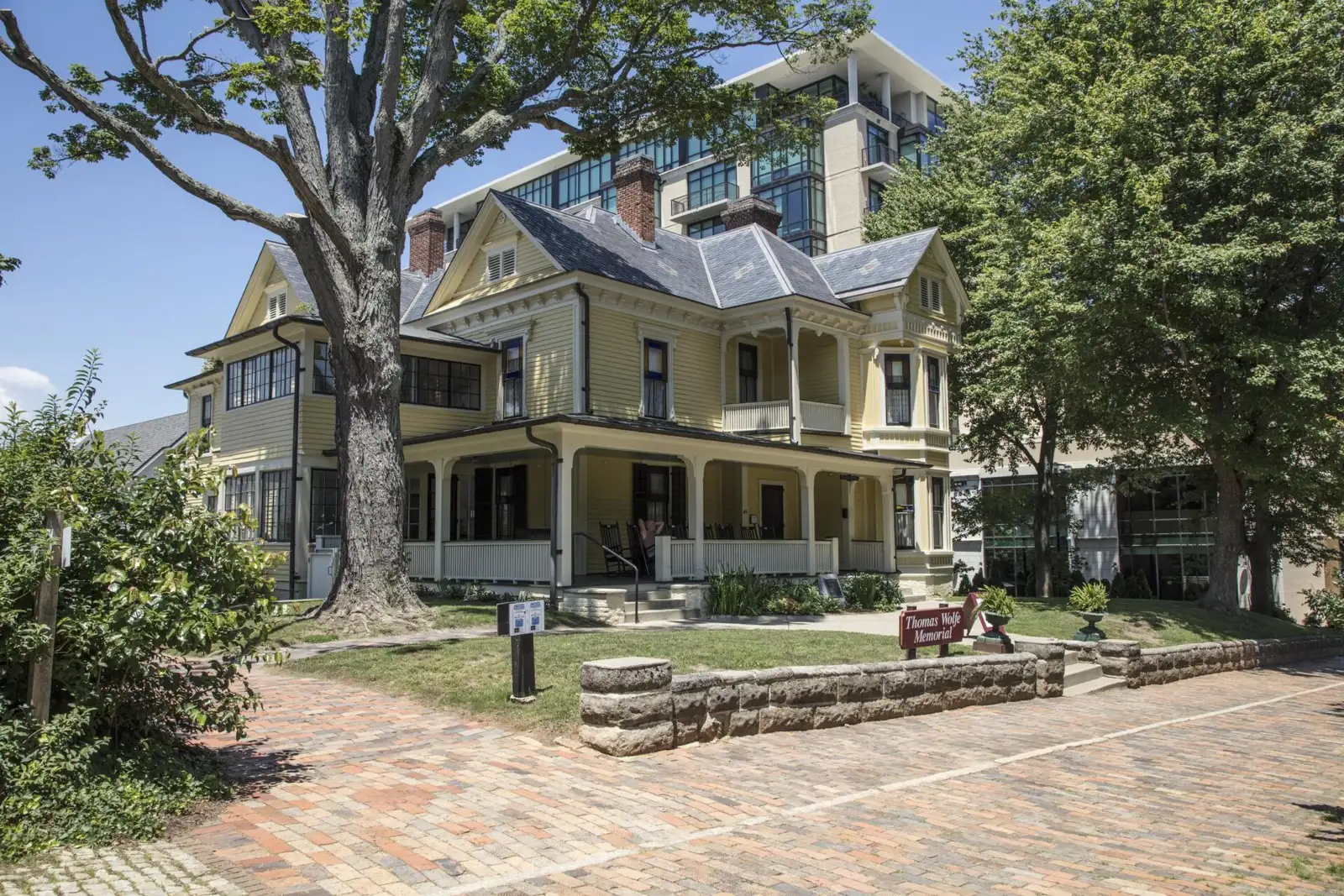
Asheville was renamed from Morristown and incorporated in 1797. The city has 87 National Register listings, from the 1966 Biltmore Estate to 2021.
Last checked Oct. 11, 2026. Facts on this page come from NCpedia, the State Library of North Carolina’s encyclopedia, the City of Asheville and the North Carolina State Historic Preservation Office’s National Register list. Thomas Wolfe Memorial: 828-253-8304.
The land around Asheville was home to the Cherokee long before European settlers arrived after the Revolutionary War. The settlement first called Morristown was renamed Asheville, for North Carolina Gov. Samuel Ashe, and incorporated in 1797, according to NCpedia. From at least 1797, the ground around today’s Pack Square Park has served as the town’s public square, the city says.
Who to call
- Thomas Wolfe Memorial: 828-253-8304, 52 N. Market St.
- City historic landmarks and districts: Historic Resources Commission
- Riverside Cemetery: 828-259-5800, 53 Birch St.
Timeline
| Year | What happened | Source |
|---|---|---|
| 1797 | Morristown renamed Asheville and incorporated | NCpedia |
| 1828 | The Buncombe Turnpike begins to open up the western mountains | NCpedia |
| 1880 | Rail service arrives (Western North Carolina Railroad) and the livestock town becomes a resort and a center of commerce and health care | City of Asheville, NCpedia |
| 1887 | George Washington Vanderbilt commissions Biltmore House, designed by Richard Morris Hunt with grounds by Frederick Law Olmsted | NCpedia |
| 1887 | A new courthouse is completed on the square, with a third-story opera house | City of Asheville |
| 1900 | Author Thomas Wolfe is born in Asheville; his first novel, “Look Homeward, Angel,” draws on the town | NCpedia |
| 1916 | The Flood of 1916 washes away Riverside Park and riverfront homes and businesses | City of Asheville |
| 1930 | Local banks fail, leaving Asheville with $41 million in debt | City of Asheville |
| 2024 | Tropical Storm Helene does at least $25 million in damage to the French Broad riverfront parks alone | City of Asheville |
The city’s 1930 debt, more than Raleigh, Durham, Greensboro and Winston-Salem combined, meant no new borrowing without a public vote, so its park system stood largely still for decades, the city says in its history of French Broad River Park.
The historic downtown
The Downtown Asheville Historic District was listed on the National Register in 1979 and enlarged by the Biltmore Avenue (1989) and Ravenscroft (1990) amendments, according to the state list. Separately listed downtown buildings include City Hall (1976), the Grove Arcade (1976), the Buncombe County Courthouse (1979), the Battery Park Hotel (1977), the S&W Cafeteria (1977) and the Young Men’s Institute, the YMI Building (1977).
Other historic districts include Montford (1977), Chestnut Hill (1983), Grove Park (1989), Biltmore Village’s Cottage District (1979), Norwood Park (2008), Proximity Park (2008), Clingman Avenue (2004), the Riverside Industrial district (2004), Sunset Terrace (2005), West Asheville End of Car Line (2006) and West Asheville-Aycock School (2006), and the Oteen Veterans Administration Hospital (1985).
The city also designates local historic landmarks, from the Grove Arcade and the Flat Iron Building to the Kress Building and the Stephens-Lee Gymnasium. Changes to them need a certificate of appropriateness from the city’s Historic Resources Commission, the landmarks page says.
Museums, sites and cemeteries to visit
- Thomas Wolfe Memorial, 52 N. Market St.: the boardinghouse where Wolfe grew up, a state historic site. Open 9 a.m. to 5 p.m. Tuesday through Saturday; closed Sunday, Monday and state holidays. Free admission; guided tours have a fee. 828-253-8304, state historic sites.
- Asheville Art Museum, 2 S. Pack Square: open 11 a.m. to 6 p.m. Wednesday through Sunday, closed Monday and Tuesday, according to the museum.
- Asheville Museum of History, at the Smith-McDowell House: set up by the WNC Historical Association in April 2023 to tell the stories of Western North Carolina’s land and people, the association says. Check its site for hours.
- Riverside Cemetery, 53 Birch St., in Montford: a garden-style cemetery that is both a burial ground and a public park, open 7 a.m. to 6 p.m., the city says. Richmond Pearson, the congressman and diplomat who built Richmond Hill, is buried there. Dogs are not allowed, except service animals.
Every National Register listing in Asheville
All 87 entries the State Historic Preservation Office lists for Asheville and its vicinity, by the year they were listed. Boundary changes and amendments are left out. The full nomination for each is linked from the state list, and the National Park Service keeps the national database.
| Listed | Property | Note |
|---|---|---|
| 1966 | Biltmore Estate | |
| 1971 | Thomas Wolfe House | |
| 1973 | Grove Park Inn | |
| 1975 | Smith-McDowell House | |
| 1976 | Arcade Building (Grove Arcade) | |
| 1976 | Asheville City Hall | |
| 1976 | First Baptist Church | |
| 1977 | Battery Park Hotel | |
| 1977 | Montford Area Historic District | |
| 1977 | S & W Cafeteria | |
| 1977 | Young Men’s Institute (YMI Building) | |
| 1977 | Zealandia | |
| 1978 | Ravenscroft School | |
| 1978 | The Manor and Cottages | |
| 1979 | 130-132 Biltmore Avenue | |
| 1979 | 134-136 Biltmore Avenue | |
| 1979 | 140 Biltmore Avenue | |
| 1979 | All Souls Episcopal Church and Parish House | |
| 1979 | Asheville Transfer and Storage Company Building | |
| 1979 | B & B Motor Company Building | |
| 1979 | Biltmore Estate Office | |
| 1979 | Biltmore Shoe Store | |
| 1979 | Biltmore Village Commercial Buildings | |
| 1979 | Biltmore Village Cottage District | |
| 1979 | Biltmore Village Cottages | |
| 1979 | Biltmore-Oteen Bank Building | |
| 1979 | Buncombe County Courthouse | |
| 1979 | Clarence Barker Memorial Hospital | |
| 1979 | Conabeer Chrysler Building | |
| 1979 | Downtown Asheville Historic District | |
| 1979 | E.D. Latta Nurses’ Residence | |
| 1979 | George A. Mears House | |
| 1979 | McGeahy Building | |
| 1979 | Richbourg Motors Building | |
| 1979 | Samuel Harrison Reed House | |
| 1979 | Sawyer Motor Company Building | |
| 1979 | Schoenberger Hall | marked gone on the state list |
| 1979 | Southern Railway Passenger Depot | |
| 1979 | St. Matthias Episcopal Church | |
| 1980 | Biltmore Industries | |
| 1980 | Overlook (Seely’s Castle) | |
| 1980 | William E. Breese, Sr. House (Cedar Crest) | |
| 1982 | Demens-Rumbaugh-Crawley House | |
| 1982 | Dr. Carl V. Reynolds House | |
| 1982 | John A. Lanning House | marked gone on the state list; listed as Asheville vicinity |
| 1983 | Chestnut Hill Historic District | |
| 1983 | William Jennings Bryan House | |
| 1984 | Reynolds House | |
| 1984 | Richmond Hill House | marked gone on the state list |
| 1985 | Church of the Redeemer | |
| 1985 | Oteen Veterans Administration Hospital Historic District | |
| 1986 | Douglas Ellington House | |
| 1986 | Ottari Sanatarium | |
| 1989 | Grove Park Historic District | |
| 1989 | Mrs. Minnie Alexander Cottage | |
| 1991 | Gunston Hall | |
| 1992 | Claxton School | |
| 1993 | Bent Creek Campus of the Appalachian Forest Experiment Station | listed as Asheville vicinity |
| 1994 | Saint Mary’s Episcopal Church | |
| 1994 | Thomas Jarrett House | |
| 1996 | Asheville High School | |
| 1996 | Asheville School | listed as Asheville vicinity |
| 1997 | (former) Buncombe County Boys’ Training School | |
| 1997 | Saint Luke’s Episcopal Church | |
| 1998 | Rice-Cornell-Brown House | listed as Asheville vicinity |
| 1999 | The Spinning Wheel | |
| 2000 | Fire Station Number 4 | |
| 2001 | Kenilworth Inn | |
| 2003 | Biltmore Hardware Building | |
| 2003 | Bledsoe Building | |
| 2004 | Clingman Avenue Historic District | |
| 2004 | Riverside Industrial Historic District | |
| 2005 | Biltmore Hospital | |
| 2005 | Broadway Market Building | marked gone on the state list |
| 2005 | Municipal Golf Course | |
| 2005 | Sunset Terrace Historic District | |
| 2005 | Whiteford G. Smith House | |
| 2006 | Thomas W. Raoul House | |
| 2006 | West Asheville End of Car Line Historic District | |
| 2006 | West Asheville-Aycock School Historic District | |
| 2008 | Norwood Park Historic District | |
| 2008 | Proximity Park Historic District | |
| 2009 | Richard Sharp Smith House | |
| 2013 | Bruce A. and June L. Elmore Lustron House | |
| 2015 | Seven Oaks | |
| 2018 | James Madison and Leah Arcouet Chiles House | |
| 2021 | South Asheville Cemetery and St. John ‘A’ Baptist Church |
What this means for you
- Own a local historic landmark? Changes need a certificate of appropriateness from the city’s Historic Resources Commission before work starts.
- The Thomas Wolfe Memorial is closed Sunday and Monday.
- More on today’s city: population and growth and parks and trails.
Frequently asked questions
When was Asheville founded?
The settlement first called Morristown was renamed Asheville and incorporated in 1797, according to NCpedia, the State Library of North Carolina’s encyclopedia. It is named for Gov. Samuel Ashe.
How many National Register historic places are in Asheville?
The North Carolina State Historic Preservation Office lists 87 National Register of Historic Places entries for Asheville and its vicinity, not counting boundary changes and amendments.
When did the railroad come to Asheville?
Rail service arrived in 1880, the City of Asheville says, turning the livestock town into a resort destination and a center of commerce and health care.
What are the Thomas Wolfe Memorial hours?
The Thomas Wolfe Memorial at 52 N. Market St. is open 9 a.m. to 5 p.m. Tuesday through Saturday and closed Sunday, Monday and state holidays. Admission is free; guided tours have a fee. Call 828-253-8304.
Have your say